Trying out the Absurd queue for AI Workloads
Posted on December 03, 2025 in python
I've been experimenting with Absurd, an experimental durable execution system by Armin Ronacher (the creator of Flask, Jinja, and Rye). It's explicitly not production-ready, but I wanted to see what kind of niche it might fill. My test case: AI workloads with expensive LLM API calls.
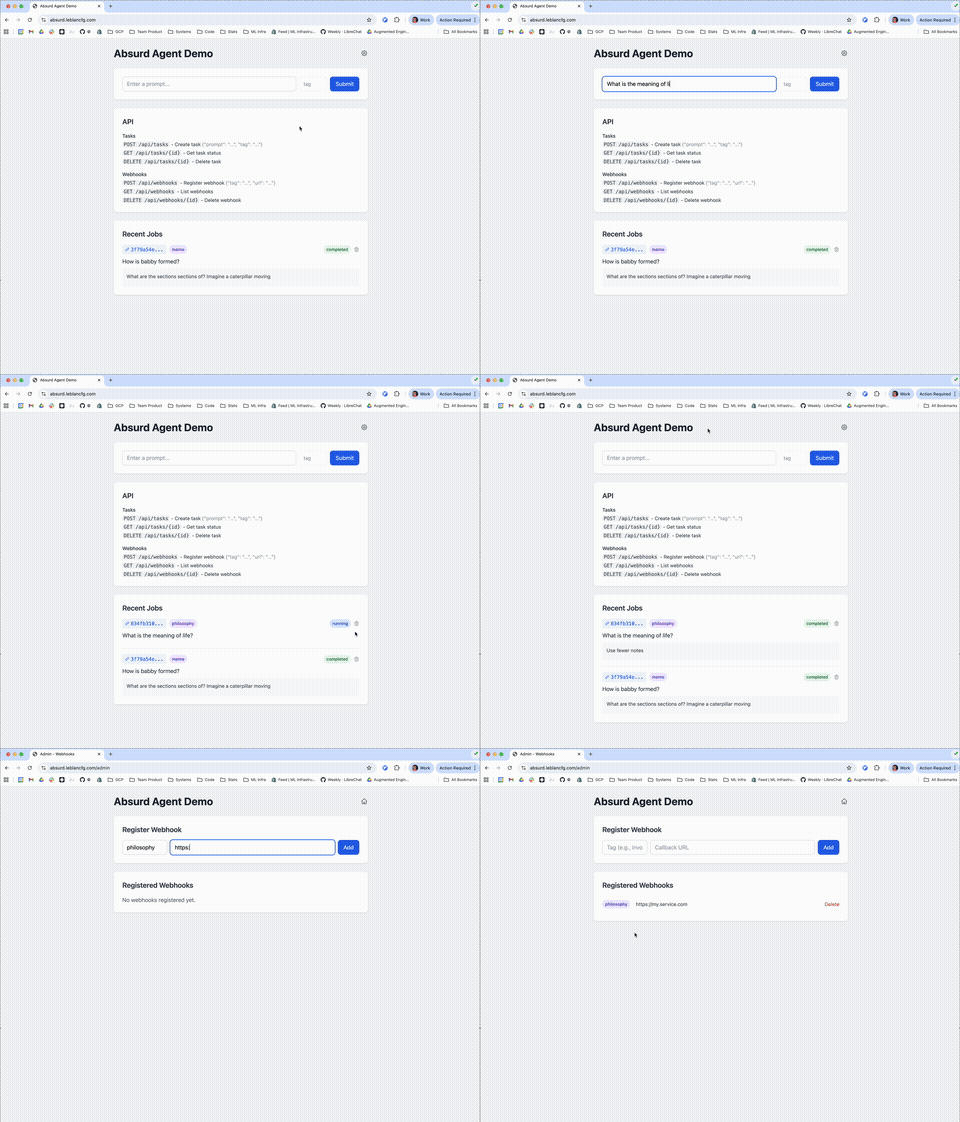
→ Jump into the demo app: absurd.leblancfg.com
→ Source code for the demo app: leblancfg/absurd-test
The Problem with AI Workloads
If you're building anything that makes LLM API calls, you know the pain: requests can take anywhere from 2 to 60+ seconds, they occasionally fail, and rate limits are sometimes unpredictable. Traditional task queues like Celery or RQ weren't designed for this. They'll restart your failed task from scratch, re-running all those expensive API calls you already paid for.
Durable execution systems like Temporal solve this by checkpointing your work as it progresses. If a worker dies, the next one picks up exactly where you left off. Self-hosting Temporal means running a multi-service cluster with its own database. There are managed options (Temporal Cloud, Inngest), but if you want something you can easily self-host alongside existing Postgres infrastructure, the options thin out.
Enter Absurd
Armin's blog post introducing Absurd explains his motivation: "durable workflows are absurdly simple, but have been overcomplicated in recent years." His approach is to put the queue logic entirely in a single SQL file that turns any PostgreSQL database into a durable task queue with automatic checkpointing.
I'm generally wary of shoving business logic into databases, but this isn't that. There's
no business logic here — just using Postgres as a queue via SELECT ... FOR UPDATE SKIP
LOCKED and
storing checkpoint state in the same transaction. The queue mechanics live in SQL; your
actual work stays in Python (or TypeScript).
If this sounds like Solid Queue from Rails 8, you're
not far off — both use FOR UPDATE SKIP LOCKED to turn your database into a job queue.
The difference is what happens when things fail. Solid Queue is a job queue: if a job crashes,
it gets retried from the beginning. Absurd is a durable execution system: it saves checkpoints
as your task progresses, so a crashed task resumes from the last checkpoint, not from scratch.
For quick jobs, this distinction doesn't matter much. For multi-step workflows with expensive
API calls, it's the whole point.
A few things that stood out to me:
Checkpoints: When your agent makes three API calls and crashes on the fourth, Absurd resumes from checkpoint three. You don't re-run (and re-pay for) work you've already done.
Self-hostable: If you're building something others might deploy themselves, asking them to also run Temporal is a big ask. Asking them to have Postgres? They probably already do.
Works with what's already there Your existing database does double duty — no new services to run.
A Practical Test
I wrote a little web app (source) combining Absurd with FastAPI, HTMX, and Pydantic AI. The setup:
- A web app that accepts prompts via API or simple UI
- Tasks queued durably in PostgreSQL via Absurd
- Workers that process tasks with automatic checkpointing
- Real-time status updates via SSE, wired up through HTMX
- Webhook callbacks when tasks complete
The worker code looks something like this:
@app.register_task(name="run-agent")
def handle_agent_task(params: dict, ctx):
    # Each step is checkpointed automatically
    ctx.run_step("mark-running", lambda: mark_task_running(params["task_id"]))

    # If we crash here, we resume from "run-agent", not the beginning
    result = ctx.step("run-agent", lambda: run_agent(params["prompt"]))

    ctx.run_step("save-result", lambda: save_result(params["task_id"], result))
If the worker dies between steps, the next worker loads the checkpoints and continues. No duplicate API calls, no lost work. The HTMX + SSE combination means the UI stays in sync — when you submit a task, it appears immediately and its status updates in real time as the worker progresses. I have a little hosted version running, but to avoid LLM costs, the worker currently just returns canned responses.
The Tradeoffs
Absurd isn't trying to replace Temporal for complex orchestration scenarios. It's intentionally minimal:
- No built-in retries with backoff (you handle that in your step functions, e.g. with the backoff package)
- No visual workflow designer
- No managed cloud offering
- Experimental software -- the README says so explicitly
The Absurd repository has SDKs for Python and TypeScript. Armin's introductory blog post is worth reading for the full context. And if you want to see a working example, my test repository shows how to wire it up with FastAPI and an AI agent framework. The Python SDK isn't published to PyPI yet, so you'll need to install it from git.
When to Consider Absurd
Absurd makes sense when:
- You're already using PostgreSQL
- Your tasks involve expensive or slow operations (LLM calls, external APIs)
- You want durability without running additional infrastructure
- You're building something that needs to be self-hostable
It's probably not the right choice if you need complex workflow orchestration, sub-second latencies, or enterprise support.
What I'd Like to See
Observability. There's no built-in metrics, tracing, or dashboards. For anything approaching production use, you'd want to know queue depth, task duration distributions, failure rates. Currently you'd instrument this yourself. There's an open issue tracking this.
Dead letter handling. What happens to tasks that permanently fail? Right now it's not clear how you'd handle poison messages or set up alerts for repeated failures.
Conclusion
For AI workloads where the main pattern is "call an API, save the result, maybe call another API," Absurd is worth looking at. It won't replace Temporal for complex orchestration, but if you're already on Postgres and want checkpointing without new infrastructure, it's a reasonable option to explore. I'll probably reach for it on my next side project that fits this pattern.